Manga chapters in. An anime episode out.

An open research pipeline that reads manga, writes a screenplay, plans shots, draws, animates and voices a full 22-minute episode on one GPU, and scores every stage against the real adaptation of the same chapters.

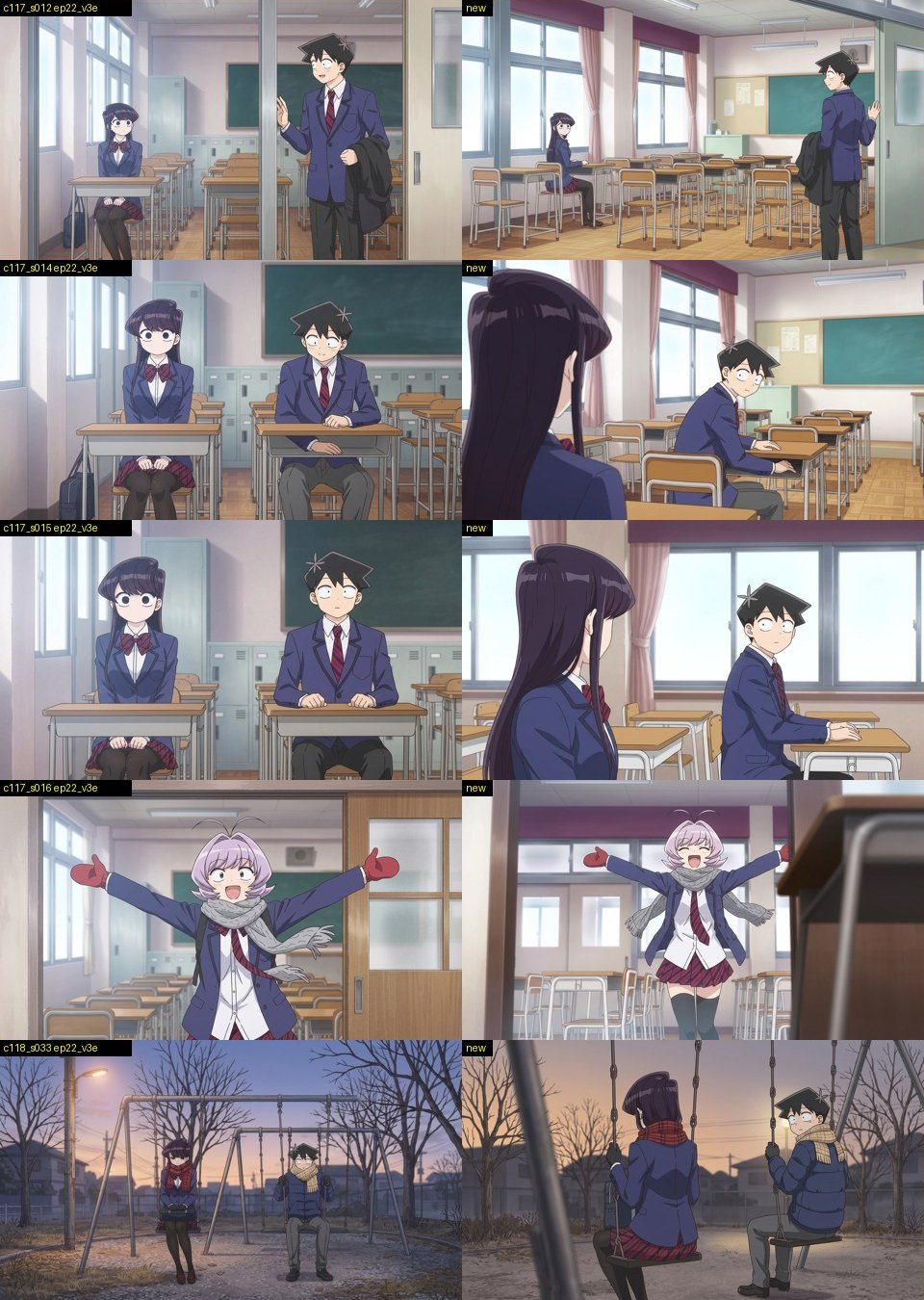
One moment, eight views: the manga panel, six generated versions from sprint 1 to sprint 5, and the shot of the real episode it is measured against.

324 shotsin a 22-minute generated episode, the real episode's count
1 GPUa shared RTX 4090; about 6 hours of rendering per episode
6 sprintseach one answers what the last evaluation found
3 episodesheld out and never trained on, as the yardstick
Demos

Excerpts of the sprint 5 episode

Generated from held-out manga chapters. Silent, with the script as subtitles: the research build's voices are conditioned on the official dub and its music comes from the show, so neither is published.

Opening: a classroom, a narrator, three people who cannot say good morning. 32 s.

Valentine's morning: an empty shoe locker, an empty desk, an entrance. 29 s.

The park at dusk: "it's a friend chocolate". 37 s.
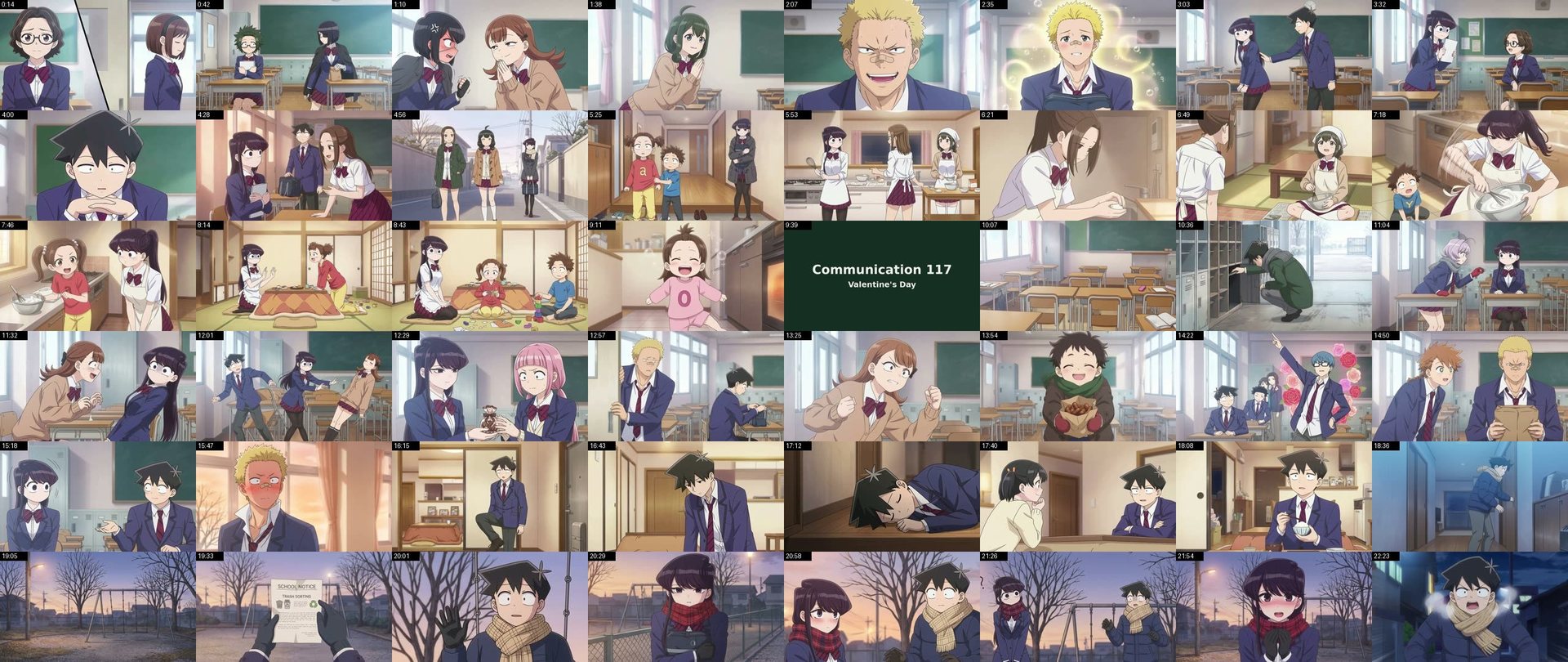
Forty-eight stills across the 22-minute sprint 5 episode

Forty-eight stills, one every 28 seconds of the episode.
Evolution

The same shot, sprint after sprint

Each grid shows the manga panel, the generated shot of every sprint, and the real anime shot that adapts the same moment. Twelve of them, with notes, in the evaluation.

Who is in the panel? Sprints 1 and 2 draw the wrong girl. From sprint 3, a vision model reads the chapter with character cards and the cast is right.

Framing. Sprint 4 drew this close-up as a boy at a desk in a wide room. Sprint 5 crops finished frames to shot sizes measured on the show.

Staging. Sprint 5 looks past one character's shoulder at the other, close to how the real shot is staged.

How it works

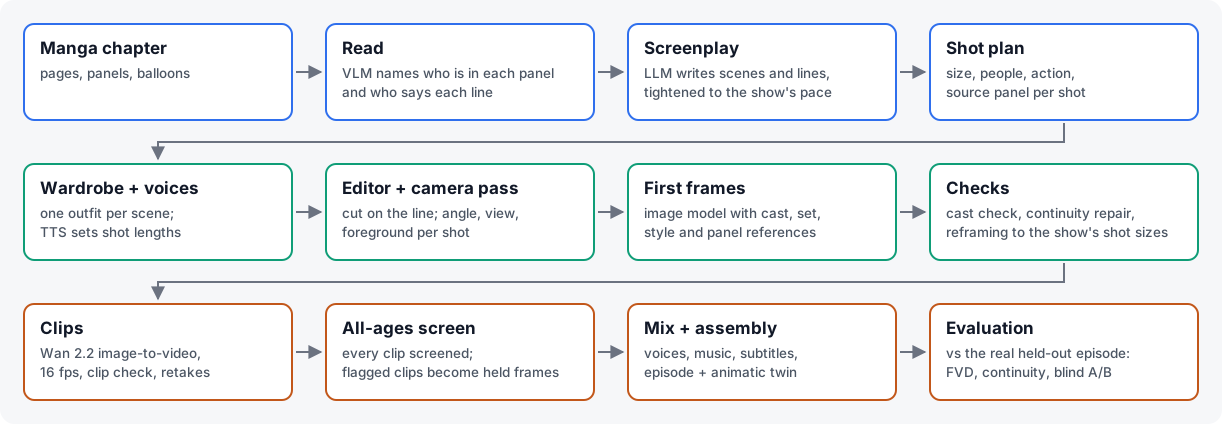
Twelve stages, each one checked

Language models read, write and direct; an image model draws first frames from reference pictures; a video model animates them; vision models check every frame and clip. Targets such as shot length, shot sizes and camera angles are measured on the training episodes.

Pipeline diagram: manga chapter, read, screenplay, shot plan, wardrobe and voices, editor and camera pass, first frames, checks, clips, all-ages screen, mix and assembly, evaluation

What the sprints found

  1. Colourised panels animate, but they are still manga. FVD 470 against the real episode.
  2. A video LoRA can hurt. A community anime LoRA doubled brightness flicker; the base model won.
  3. The bottleneck was reading and directing. Cast accuracy on hand-labelled panels went from 61 % to 100 % once a vision model read the chapter with character cards.
  4. Reference-drawn frames fix cast and continuity, and lose the look. Scene continuity reached the real episode's level while FVD rose from 346 to 514.
  5. Half of "the look" was framing and frame rate. Cropping to measured shot sizes and playing at 16 fps brought FVD back to 390.

Sprint 6, in progress

Blind raters named stock-looking sets, costume details and flat staging first. The next cut shows the painter the school's real rooms, reads uniforms off the show's own character pictures, and adds a camera pass. In a blind test on 24 shots the new frame was closer to the show in 21 of 23 decided pairs.

Sprint 5 frames beside sprint 6 test frames of the same shots

Left: sprint 5. Right: the same shot in the sprint 6 test.

Results

Measured against the real episode

A full episode from four held-out manga chapters, compared with the real episode that adapts them.

Sprint 1Sprint 2bSprint 3Sprint 4Sprint 5Real episode
FVD against the real episode (lower is closer)470326–333346514390321 (floor)
Cuts that stay in the same scene—53 %76 %94 %92 %91 %
Continuity errors per 100 cuts—7.110.01.62.31.2
First frames accepted by the cast check——157 / 286284 / 286316 / 316
Mean optical flow———0.090.330.73
Blind A/B, clip against its animatic201 : 86212 : 94—276 : 9289 : 15
Against the real episode nothing is won yet. Two independent blind raters picked out the generated side in 160 of 160 judgements and preferred the real frame or clip in about 33 of 40 pairs. The raters here are an automatic vision judge and blind AI raters; a human has rated 6 pairs so far. Definitions, caveats and every number: evaluation.
Support

Help it go further

MangAnime is built and run by one person on one shared 24 GB card: the image, video and voice models take turns in memory, and one episode render blocks everything else for six hours.

Star the repository

Free, and it is how other people find the project.

★ Star MangAnime

Fund the next GPU

US$7,000

One NVIDIA RTX PRO 5000 (48 GB): all three models loaded together, local fine-tuning, rendering and evaluation side by side. The fundraiser page is being set up.

What it would change

Sponsor or collaborate

Studios, labs and individuals who want to sponsor the work, lend compute or collaborate on evaluation.

Open a discussion